Dark nebulae
A hole in the sky
“Absorption nebulae or dark nebulae are clouds of gas and dust that don’t emit or reflect light, but block light coming from behind them.” They “tend to contain large amounts of dust, which allows them to absorb visible light from stars or nebulae beyond them.”[source]
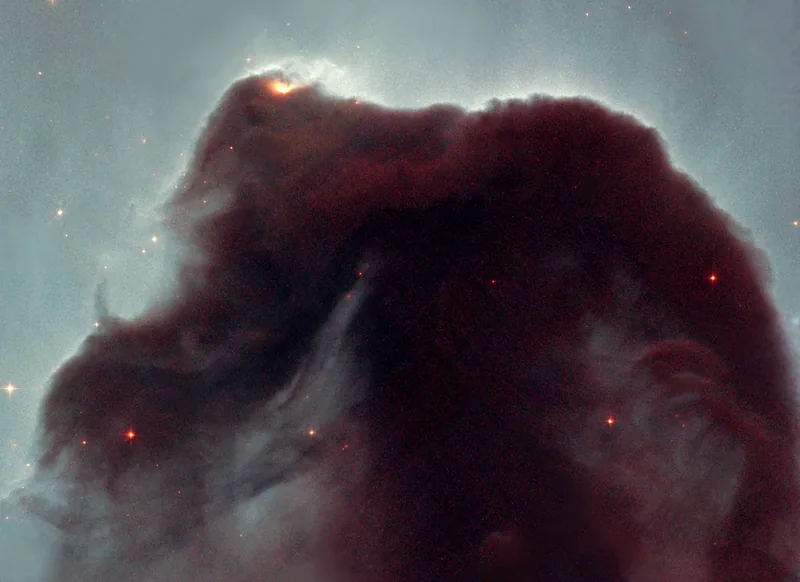
William Herschel, “discussing these seemingly empty spots in the late 1700s, called them “a hole in the sky.””[source] The Horsehead Nebula, also known as Barnard 33, is the dark silhouette on this page, in a 2001 Hubble close-up. It is not an empty place. It is dust, standing in the way of the light.
Those clouds are part of a much thinner sea. Hubble’s nebulae page says nebulae “are made up of gas — primarily hydrogen and helium —and fine cosmic dust.” They are “part of the interstellar medium of extremely low-density gas and dust that exists between stars in the void of space, material so dispersed through the vastness of the cosmos that it can have a density as low as 0.1 atoms per cubic centimeter.” A cubic centimetre of the air we breathe, that page says, holds about 10 million trillion molecules.[source] A dark nebula is not a vacancy. It is a place where that thin medium has grown dense enough to hide what is behind it.
“Nebulae happen in places where the interstellar medium has become dense enough to form clouds. That could be because gravity has pulled the gas and dust together, or because stars have died and spewed their contents into the cosmos.” Official pages add that several types “often live side by side.”[source] A silhouette like the Horsehead is usually seen against someone else’s glow.
NASA’s decoding page says the same thing in visitor language: there are nebulae “with dust so thick that we’re unable to see the visible light from young stars shine through it. These are called dark nebulae.”[source]
Official pages also mention Bok globules among absorption nebulae: “small, cold clouds of gas and dense cosmic dust.” “Some Bok globules have been found to have warm cores, which would be caused by star formation inside, and further observation has indicated the presence of multiple stars of varying ages, suggesting a slow, ongoing star formation process.” They “may form stars, or may eventually dissipate.”[source] This desk does not pin that class name on the dark shape in NGC 1999, whose older Heritage identification was later revised.
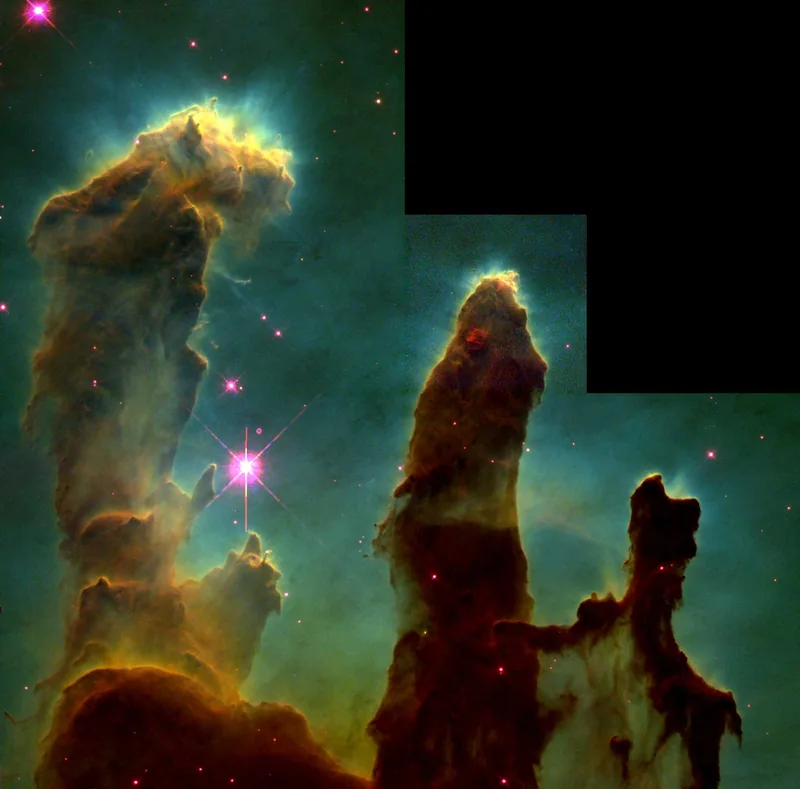
One last caution, about a famous photograph rather than a famous cloud. In the 1995 Hubble mosaic of the Pillars of Creation, the black rectangle at upper right is the camera’s stairstep detector gap, not a hole in the Eagle Nebula. Herschel’s “hole in the sky” was a remark about dark clouds. The rectangle is a remark about a camera.
Enjoyed this nebula desk?
No pop-ups. No intrusive advertising. Just interesting stuff. A little support helps the next galaxies.im site get built.