Reflection nebulae
A streetlamp in the fog
“Not all nebulae emit light of their own,” NASA’s decoding page says. Some “scatter the light of stars hiding in or near them. These are called reflection nebulae and are a bit like seeing a streetlamp illuminate the fog around it.”[source]
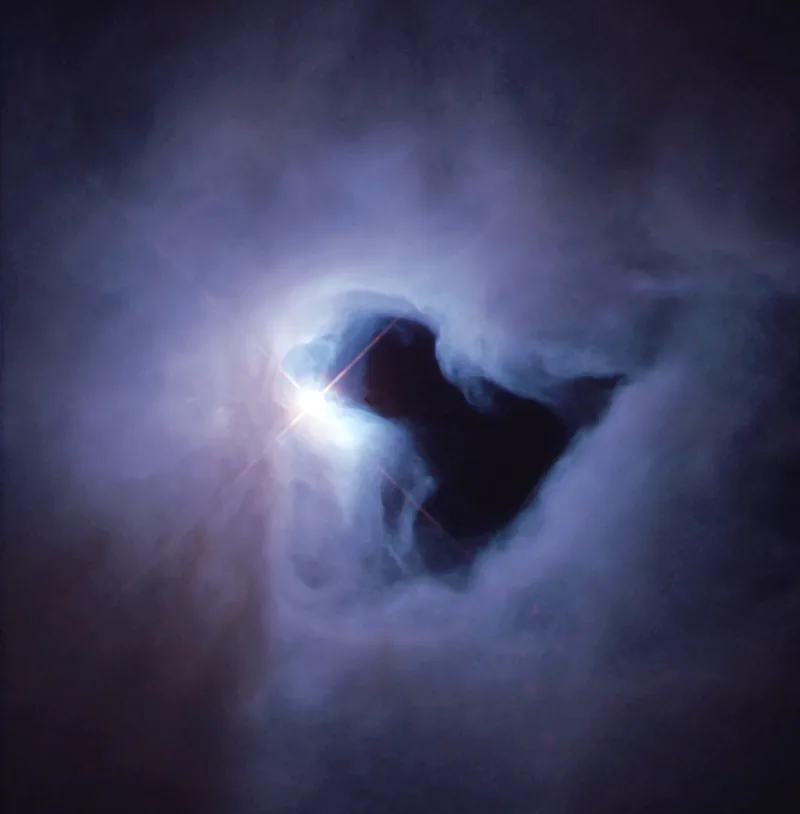
Hubble’s nebulae page adds a reason for the colour. “Because of the way light scatters when it hits the fine dust of the interstellar medium, these reflection nebulae are often bluish in color.”[source] NGC 1999 “lies close to the famous Orion Nebula, about 1,500 light-years from Earth. The nebula is illuminated by a bright, recently formed star called V380 Orionis, and the gas and dust of the nebula is material left over from that star’s formation.”[source]
A 2000 Heritage caption once called the dark shape in NGC 1999 a Bok globule. Later work found it is a hole in the cloud. This site describes the reflection nebula, and the dark shape, without repeating that older identification as current fact. Official pages still use “Bok globules” as a class of small, cold, dark clouds — just not as a label this desk pins on NGC 1999.[source]
A second official example is not leftover birth-cloud at all. “Most nebulae around star clusters consist of material that the stars formed from. But the Pleiades shines on an independent cloud of gas and dust, drifting through the cluster at about 6.8 miles/second (11 km/s).”[source] The cluster is lighting a visitor.
Hubble’s nebulae page sets the physics of that borrowed light in one paragraph. “Reflection nebulae reflect the light from nearby stars. The stars that illuminate them aren’t powerful enough to ionize the nebula’s gas, as with emission nebulae, but their light scatters through the gas and dust causing it to glow – like a flashlight beam shining on mist in the dark.”[source]
A Heritage caption on the decoding page adds why the colour is so often blue. “Unlike emission nebulae, whose reddish glow comes from excited atoms of gas, reflection nebulae have a bluish cast as their interstellar dust grains preferentially reflect blue starlight.”[source] The flashlight, the streetlamp, and the bluish mist are three official pictures of the same kind of cloud.
Enjoyed this nebula desk?
No pop-ups. No intrusive advertising. Just interesting stuff. A little support helps the next galaxies.im site get built.