Emission nebulae
A neon sign, and four very young stars
In an emission nebula, NASA’s decoding page says, “stars heat up the clouds of gas, whose chemicals respond by glowing in different colors. Think of it like a neon sign hanging in a shop window!”[source]
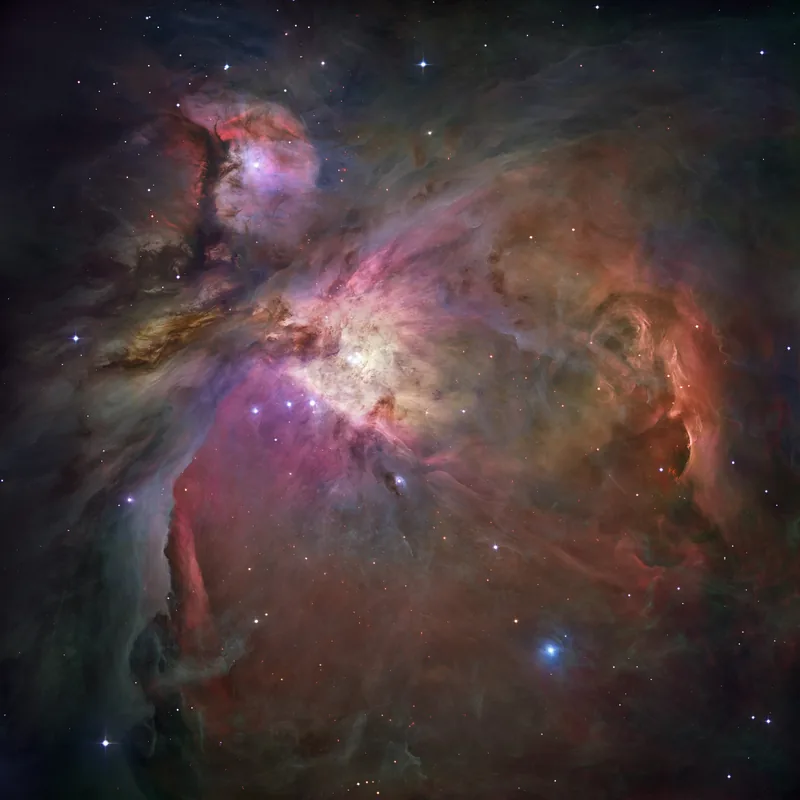
Hubble’s nebulae page fills in the physics. When electrons recombine with atoms, “they emit energy in the form of light, causing the nebula's gas to glow.”[source] The Orion Nebula, that page says, “is a picture book of star formation, from the massive, young stars shaping the nebula to the pillars of dense gas that may be the homes of budding stars.”[source]
At the bright centre sits the Trapezium, a group of four massive stars. “These stars are only a few hundred thousand years old, about 15-30 times the mass of our Sun, and so hot and bright that they're responsible for illuminating the entire Orion Nebula.” Thousands of additional, mostly young, stars are embedded in the cloud. “The most massive are 50 to 100 times the mass of our Sun.” Their radiation “carves a cavity in the emission nebula and disrupts the growth of hundreds of smaller stars.”[source]
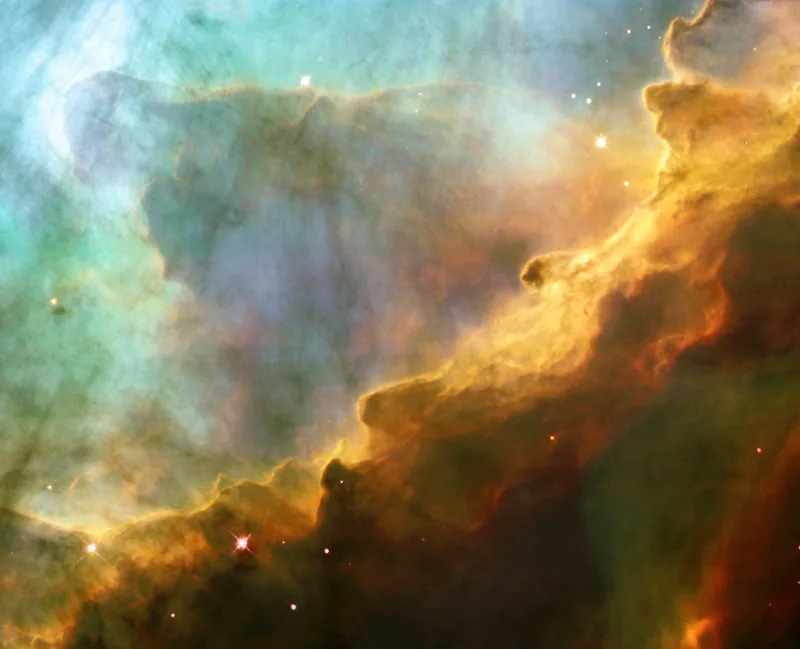
The Omega Nebula, also called the Swan, is another official emission landscape. A 1999 Hubble still in NASA’s archive says it is “a hotbed of newly born stars residing 5,500 light-years away in the constellation Sagittarius,” with wavelike patterns “sculpted and illuminated by a torrent of ultraviolet radiation from the young massive stars, which lie outside the picture to the upper left.”
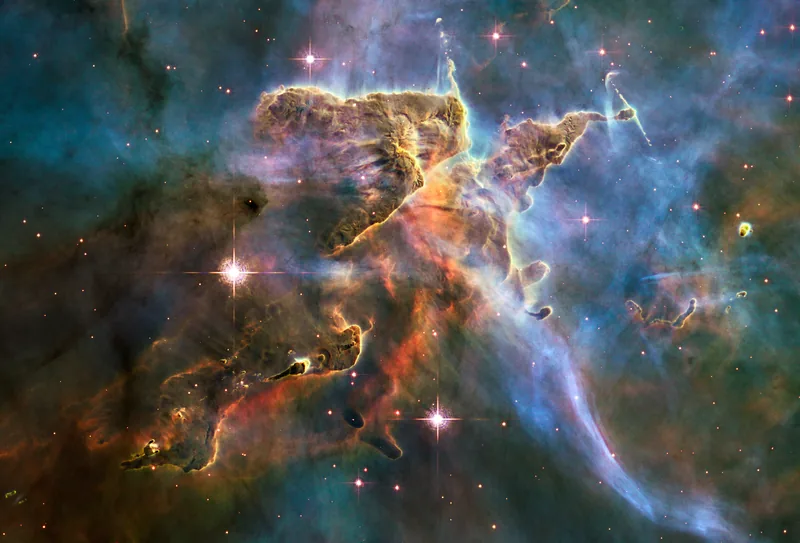
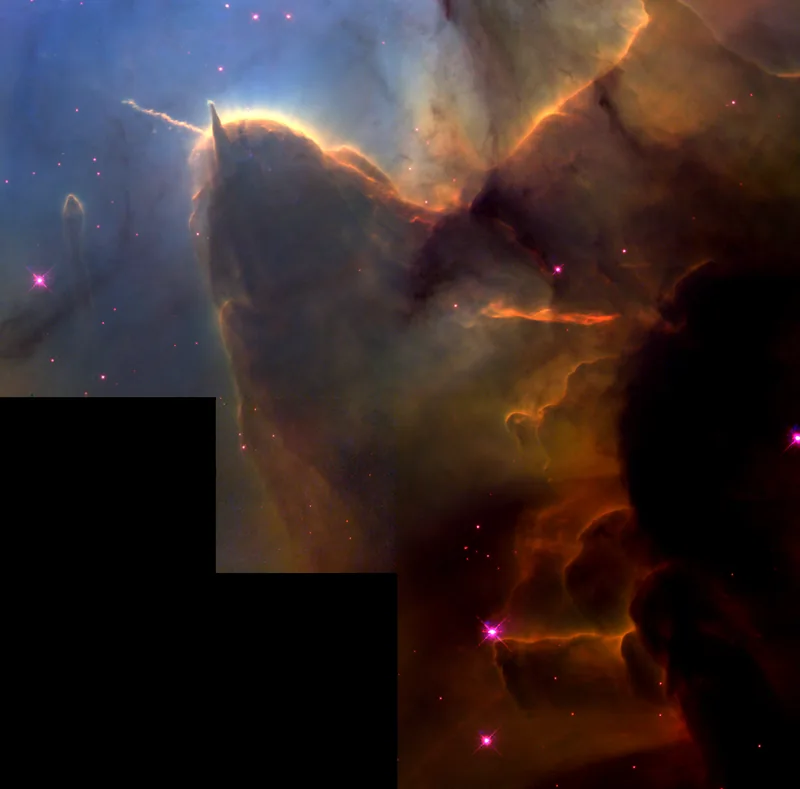
The Trifid, in a 1997 Hubble photograph, is a stellar nursery in Sagittarius “about 9,000 light years from Earth.” NASA says a nearby massive star is tearing a cloud of dust and gas apart, a cloud “about 8 light years away from the nebula's central star.”
Hubble’s nebulae page gives the general rule behind those carved landscapes. “The radiation and solar winds of stars within emission nebulae carve and sculpt the nebula’s gas, creating caverns and pillars but also creating pressures on the gas clouds that can give rise to more starbirth.”[source]
Enjoyed this nebula desk?
No pop-ups. No intrusive advertising. Just interesting stuff. A little support helps the next galaxies.im site get built.