For families
Five kinds of cloud, told carefully
Nothing here needs a login, and nothing jumps out at you. The desk on the home page is a good place to start: pick a kind of nebula, then follow a link.
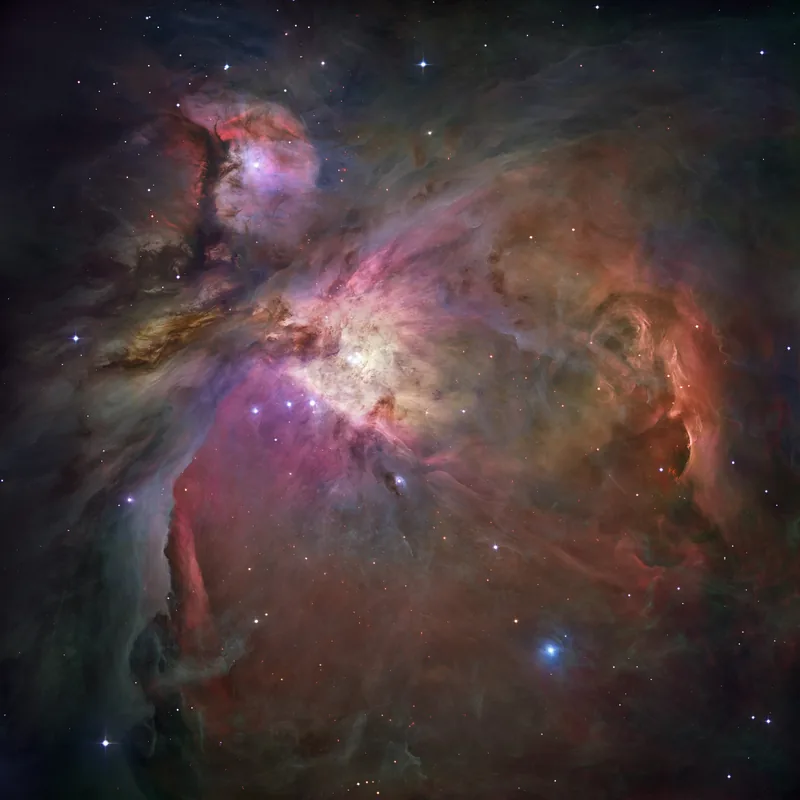
A simple path: emission and the neon-sign comparison, then the Trapezium’s very young stars. Then planetary, and why the name is a historical accident. Then the Crab, bright enough for daylight in 1054. If someone asks about the Horsehead, the dark nebulae page has Herschel’s “hole in the sky.”
NASA’s decoding page has a story that is easy to start with. “Did you know our Sun got its start in a stellar nursery? Over 4.5 billion years ago, some gas and dust in a nebula clumped together due to gravity, and a baby Sun was born.” Making a baby star “can take a million years or more.” Much later the Sun “will eventually puff into a huge red giant star before leaving behind a beautiful planetary nebula,” and a white dwarf “that will cool down very slowly.” Official wording adds that the universe does not yet seem old enough for any white dwarf to have cooled completely.[source]
The same official pages like to make the emptiness of space feel exact. Between the stars, gas and dust “can have a density as low as 0.1 atoms per cubic centimeter.” A cubic centimetre of the air in the room holds about 10 million trillion molecules.[source] The clouds on this site are the places where that thin stuff has gathered into something you can photograph.
Because the Sun will outlive us, “scientists can’t observe its whole life cycle directly … but they can study tons of other stars and nebulae at different phases of their lives.” The decoding page’s last line is a good one to leave with: “While studying nebulae, we’re seeing the past, present, and future of our Sun and trillions of others like it in the cosmos.”[source]
The quiz has ten questions from those official sentences. The timeline can be read in order, or used as a short game of official years. The fact sheets are typographic PDFs, A4 and US Letter, with no photographs inside: kinds of nebula, a historical name, and the Crab of 1054.
Enjoyed this nebula desk?
No pop-ups. No intrusive advertising. Just interesting stuff. A little support helps the next galaxies.im site get built.