Supernova remnants
Bright enough for daylight, in 1054
A supernova remnant is what is left when a massive star explodes. Hubble’s nebulae page takes the Crab as its example. “The explosion that created it in the year 1054 was so bright that for weeks it could be seen even in the daytime sky, and it was recorded by astronomers across the world.”[source]
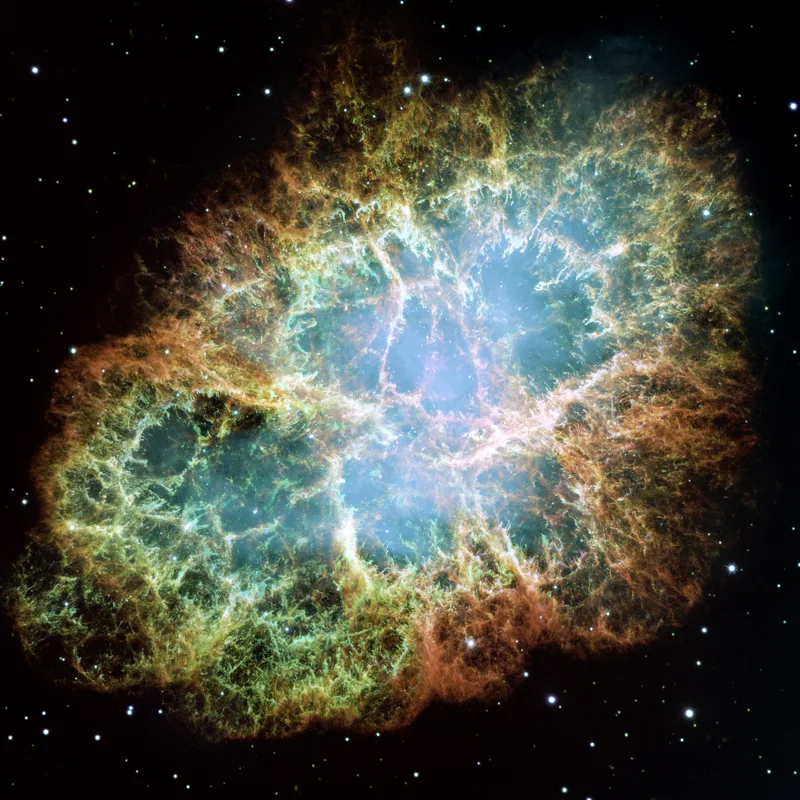
“The material from the star is still rushing outward at around 3 million mph (4.8 million kph).” The Hubble mosaic “is the highest resolution image ever made of the entire Crab Nebula, which is located 6,500 light-years away.” “The orange filaments are the tattered remains of the star and consist mostly of hydrogen.” A rapidly spinning neutron star at the centre is “the dynamo” of the remnant.[source]
The official caption of the photograph on this page describes a six-light-year-wide expanding remnant of that 1054 explosion. The width in the caption and the 6,500 light-year distance on the nebulae page are kept as written, on the pages that wrote them.
“Not all stars die gently, exhaling their outer layers into space. Some explode in a supernova, flinging their contents into space at anywhere from 9,000 to 25,000 miles (15,000 to 40,000 kilometers) per second.” That happens “when a star has a lot of mass – at least five times that of our Sun – or is part of a binary system in which a white dwarf star can gravitationally pull mass from a companion star,” and the explosion “can explode with the brightness of 10 billion Suns.”[source]
“Supernova remnants consist of material from the exploded star and any interstellar material it sweeps up in its path.” New debris and earlier ejecta “collide, heating up in the shock until it glows with x-rays.” The remnant’s glow “can also be powered by the stellar wind of a pulsar – a rapidly spinning neutron star created from the core of the exploded star. The pulsar emits electrons that interact with the magnetic field it produces, a process called synchrotron radiation, and emits X-rays, visible light and radio waves.”[source]
The official mosaic caption puts that dynamo in view. “The blue light comes from electrons whirling at nearly the speed of light around magnetic field lines from the neutron star, which is the crushed, ultra-dense core of the exploded star.”[source] NASA’s decoding page adds that Chandra, looking in X-rays, “sees high-energy X-rays from a pulsar” in the Crab — “a type of rapidly spinning neutron star, which is the crushed, city-sized core of a star that exploded as a supernova.”[source]
This is a different death from a planetary nebula. Planetary nebulae, official pages say, form when low- to medium-mass stars expel their outer layers. The Crab is the wreck of a much more violent event, still bright enough, a thousand years later, to be one of the most photographed objects in the sky.[source]
Enjoyed this nebula desk?
No pop-ups. No intrusive advertising. Just interesting stuff. A little support helps the next galaxies.im site get built.